

Hello Friends,
Welcome to my new post. Hope you enjoy reading the same !!
Due to some prior commitments, I was not able to come up with a blog post for a long time. Even though the trek was completed in 2021, I am posting this in 2022 (making it the first post of 2022).
Mr. Vishwanath of Summiters had told me about this trek in 2017, when we had trekked the Kudremukha peak together. He even invited me to join him for the Netravathi peak trek from ever since, but I wasn’t able to join him due to personal reasons.
Fast forward to December 2021… Vishwanath and myself were talking about his upcoming schedule for the year, and that is when he reminded me again about the Netravati trek . He was planning to go with a small team during the second week of December 2021, and I immediately agreed to join him come what may. Eventually, the trek was arranged on 11th and 12th of December, 2021
I then discussed about this trek with some of my friends, and a couple of them agreed to join me.
Each trek is extremely exciting and careful planning makes the trek memorable. In this regard, I spoke to my friends and decided on the trek plan the previous day.
The Journey :
10th December, Friday :
Vishwanath had asked the team to meet at Nagasandra metro station by 9.30 PM where a tempo was arranged to pick us.
Bhargav, Meghana and myself stay close-by and we decided to meet at Yelachenahalli station and go together. If you have read my earlier blog about Ettina Bhuja, you will be aware of Bhargav and Meghana (this couple are actually couples 😀)
While I was waiting for my friends at the Metro station, I tried my hands on mobile photography. The interiors of Metro station in Bangalore are very intriguing for photographers.
 |
| Namma Metro welcoming the passengers ! |
We met the whole team at Nagasandra station, and our journey towards the western ghats started. It's always very nice to meet new people, and this is what makes the trek interesting. After a short introduction by team members, Vishwanath briefed us on the trek. We were all so engrossed in the discussion, that we failed to notice that we were already on the Hassan highway. A short break at one of the restaurants was a great refresher for all of us.
Within no time, people started to hit the bed only to be awakened by the steep curves of the Western Ghats. That is when we realised it was 4.30 AM and we were almost close to our homestay.
After we passed through the quaint hilly town of Kalasa, I realised that we had entered the Kudremukh limits. The tempo stopped near a place called Guthyadka, where an open jeep from the homestay was ready to pick us up.
We all got down from the tempo to only realize how cold and dark it was outside. The cold December winds made people to shiver, and some of us even thought 'Do we still need to do this trek 😀 ' ?
The crystal clear sky was exposing all its gems throughout the night, and we could clearly see the Orion Constellation & Orion Nebula among many other celestial objects.
We then hopped on the open jeep, and little did we know that it was a journey of another 6kms uphill on a bumpy road. While many of them were counting the stars, some of them were even counting for their broken bones 😀
11th December, Saturday :
The skilful driver took us to the homestay within 30 mins and it was still pitch dark outside. Vishwanath suggested that we take some rest for a couple of hours and start the trek with fresh energy. We followed his advice promptly and hit the bed in no time. All of us woke up around 7.30 AM and finished the morning chores by 8AM. By then, the hosts had prepared super delicious breakfast which comprised of Idli- chutney, Avalakki (poha) and piping hot filter coffee.
Sipping a cup of hot Filter Coffee in the land of Coffee is nothing short of heaven.
 |
| Our home for the next two days |

 |
Isolated homes as seen from the forest trail |
What makes this trek interesting and totally worth it ?
This trek is a combination of Adrenaline Terrains like Crossing streams, Hiking the Emerald grasslands, Soaking yourself in the Waterfalls and then Climbing the mountains covered with clouds before you finally conquer the 1500m peak.
(You will find out the answer by yourself at the end of the blog... Keep reading !!)

It was now a break time for all of us as we enjoyed the beauty of the place by sitting on a huge rock besides us. It was also a time where we could examine ourselves for Leeches.


After enjoying the beauty of the mountains, it was time for us to hit the track soon.

The ascent is gradual from here onwards and you get to see the neighbouring hills in a close vicinity. The houses start to appear smaller and smaller once you start ascending.

The Light plays hide and seek with every passing minute, and this drama is a spectacle in itself.
 |
| Play of Light on the mountain ridge |
We now enter back to the forest through a small patch of grassland which makes way for our next pitstop (a small waterfall). This place is great to relax and rejuvenate ourselves.

Many of our teammates were eager to take a dip in this waterfall. However owing to stricter timelines, we made a promise to ourselves that we enjoy in the waterfall while returning. This decision helped us gain more time to trek and enjoy the summit.

As I said earlier, the play of hide and seek between Sholas & Grasslands and the Lights & Shadows, makes this trek more enjoyable.
After ascending to the top of the current hill, we now start to descend to the other side of the hill.

Descending means, we are now entering back to the Shola forests. Didn't I tell you? ... That's the fun part of this trek

Can you see the trek path in the above image? That's where we have to climb... Netravathi peak is beyond these hills and cannot be seen from here yet.

 |
| Descending trekkers |
In about 20 minutes from this point, you will arrive at a small stream which is a rivulet of Netravathi river itself. This was our next pitstop...

This is where you can refresh yourself, fill water bottles and resume the trek. It is actually a breather which is seldom seen in many treks. A good water source makes the trek extremely rewarding.
Just while we were relaxing on the rocks, our teammate Prajna spotted a snake. To my dismay, it was a cat snake.

This path can be very tricky to cross during monsoons as the water might be gushing and rocks will be slippery. It is advised to go in groups during this time. It is also very challenging to not get your shoes soaked in water atleast once. I actually removed my shoes, crossed the water in bare foot and then wore the shoe again.
From here onwards, it is a constant steep ascent. You will have to cross two such hills before you actually start hiking towards the Netravathi peak.

One has to follow the trail as seen in the above image. Two hills beyond this point is where Netravathi peak resides.
As you can see, it's a constant ascent and most of the trekking time is consumed on this trail.

All of us screamed with joy on reaching the top of the hill after all the gasping and panting. This joy vanished in a second when Surendra, our guide told us that Netravathi peak is still far away and cannot be seen from here yet.
Most of us sat there itself, and took deep breaths before we continued the journey.

The final stretch was quite steep and filled with tall grass. This made the trail barely visible.
By around 12.30 PM , we made it to the top of the Netravathi peak and our happiness knew no bounds. It was extremely ecstatic as we all jumped with joy.


Some of them rested , while some of them were busy clicking photographs. The speed of the clouds made me to shoot timelapse videos which can be seen below.
1) Gadai kallu :
This place is also called as Jamalabad and there is a well known trek to this hill. Gadai kallu can be seen exactly in front of you upon reaching the Netravathi peak

2) Netravathi river valley :

3) Other well known peaks :

The team :
 |
| From L to R : Myself, Vishwanath, Prajna , Meghana , Bhargav and Mrs. Shylaja |
Mrs. Shylaja was always leading from the front and her speed was unmatchable. I actually thought that she may be around 40 years, but when we found out that she was 60, we were awestruck. She is working as a principal in a very reputed school and has also travelled many countries. She has also completed many Himalayan treks and was a true inspiration for all of us !


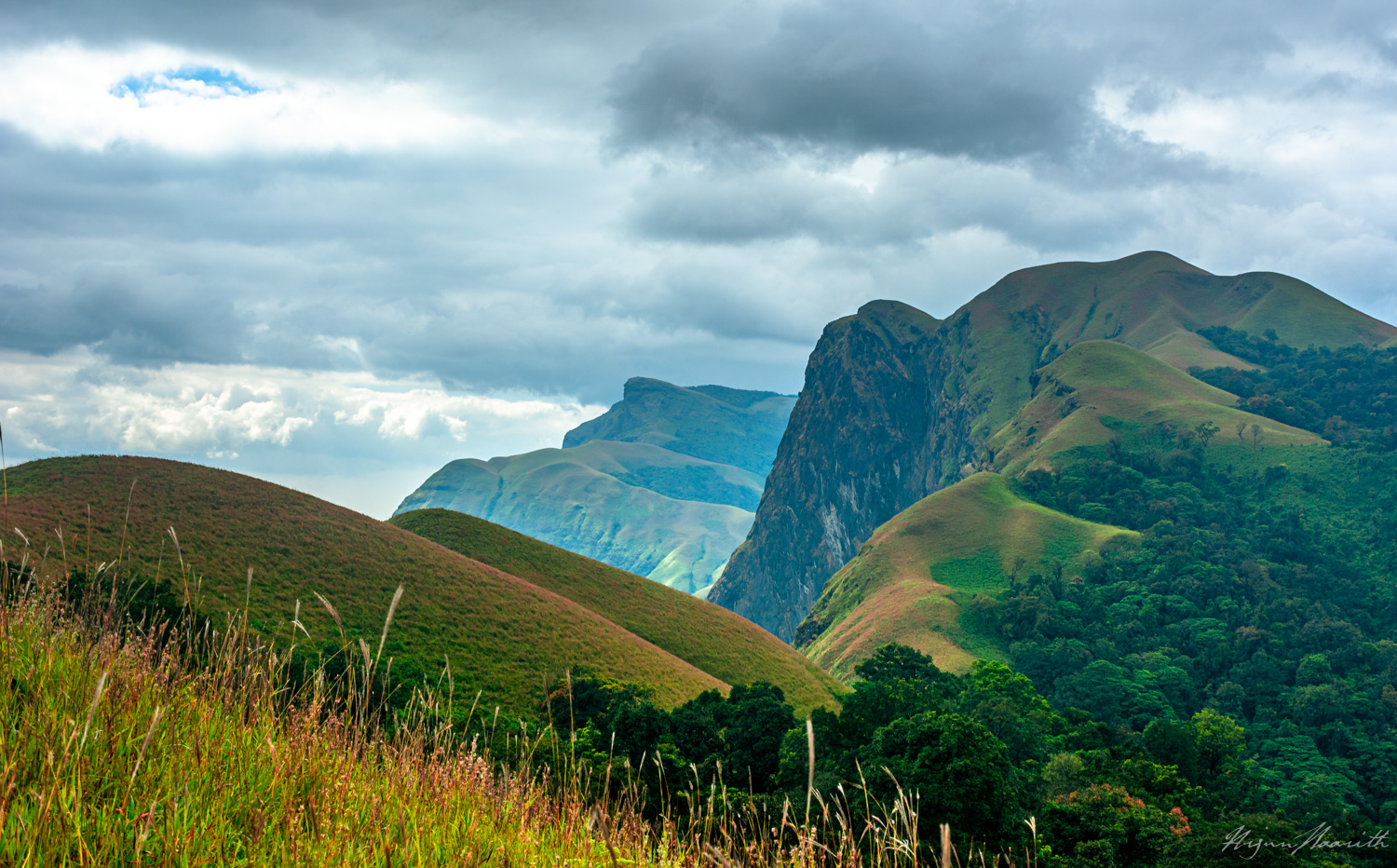
I generally prefer to trek post monsoons, just for the greenery. However, in this trek I realised the importance of other colors too. Since it was the onset of winter, the green grass had slowly started to turn golden brown. The myriad hues of Greens , Yellows , Goldens and Reds made the place nothing but Heaven in all its glory.

The descent was pretty easy, with gradual slopes descending to the valley down below. It was more of a straight walk with undulations here and there.
 | |
|
 |
| Iris During the descent, I spotted this lovely flower and mistook it to be the endemic 'Neela Kurinji', and later Vishwanath clarified it as Iris.  During landscape photography, it is not always the wide angle that matters. Even a telephoto lens would help you create wonders.  When Kudremukha peak starts to fade away, that means you are descending on the right trail |
 |

As you can see in the above image, Shylaja ma'am was well ahead of us even during the descent. The couple-duo and myself kept on descending slowly by capturing everything that we could see.


Small patches of grasslands were lit while the other patches were in shadows. This made the whole scene a lot more dramatic.


12th December, Sunday :

After shooting timelapses (https://youtu.be/xtcfXq6TMrQ?t=46), we returned to the homestay for breakfast.


We reached Bangalore by 10 PM and bid a heartfelt goodbye to the entire team, hoping to meet again !!
Netravathi Peak Trek Guide :




